Feeds:
Posts
Comments

2009alison_des_forges

The death of Alison Des Forges on flight 3407 last week is a terrible loss to all of us, the whole wide world. She was 66 and working til the day she died. It feels close to me since I only discovered her last year, but I read her daily for months and just knowing she is in the world has made it a little better since then. Now she’s dead and I need to say something but don’t have the words to do it justice. This is a blog and links are sufficient so I’ll go that route, but just have to say god bless her work and goddamn the world that created a need for it.

Huffington/Common Dreams: A Heroine for Human Rights.

Human Rights Watch: “…the epitome of the human rights activist”

Democracy Now! Interview with HRW Executive Director and video clips.

Slate: What Are They So Scared of? I’m Just a Little Old Lady.”

She was banned from her beloved Rwanda last year for insisting the Kagame government account for war crimes, scorned the forgiveness & reconciliation policy as empty therapeutics,  was the first to call the massacres a genocide and wrote the definitive text, testified 11 times before the International Criminal Tribunal, and when the MacArthur Foundation recognized her with a “genius grant” she tried to give the money back. I’m struck that each one of these sentences could flesh out a book, but she also bargained for her own life with drunken militias at roadblocks, buried scores of nameless dead while saving countless others, and saw the genocide looming well before anyone else and pleaded with Washington to take action. About that she gives an unforgettable account of a visit at the State Department with Pru Bushnell, who would herself become utterly thwarted by the Clinton administration:

It was the very first meeting — perhaps it was the meeting after that. But I do remember a meeting where we were all sitting together there, four or five of us. She had a staff person with her. It happened that we were all women, and perhaps because we were all women, we weren’t afraid to cry. So we talked about the situation. I remember we then all cried, all of us. Then Pru took out her box of Kleenex and passed it around. We all blew our noses and she said, “OK, now what are we going to do next?” (via)

We all know how that turned out. But it took Alison Des Forges to make what’s rightly considered Biblical sense of it.  Human Rights Watch has an active tribute page with hundreds of very moving comments in honor of her legacy, though my own favorite comes from the New Yorker: Apparently, anything Des Forges did that was connected with Rwanda, she did with all her might. And she managed to do it without the self-righteous territoriality that is the occupational vice of human-rights experts. Her attachment to the country and its people seemed neither saintly nor professional, but entirely human.</em>

All of us — smokers, unbelievers and Muslims, coming together in the winter of our hardship  to celebrate the awesome sight of 2 million people sniffling and burbling in subfreezing temperatures, even our magazine cover partied! The self-conscious hipsters are right — too much joy will be used as proof we’ve turned Hussein X  Superfly into a personal savior, but he covered that yesterday and it bears repeating: This isn’t about him, it’s about us, we the people.

Commie lyrics included!

I was a little loopy but half-heard a woman on the mall explain what good government is and is not: it’s not an implacable force impinging on people or faceless source of indiscriminate largesse, but a partnership between the governing and the governed; both have a duty to listen to and be influenced by the other. I haven’t seen that yet, have lived through eight presidents and have never seen anything come close til now and don’t get me started on Clinton, if anything he was doubly revolting for being a Democrat, which made this my favorite jaw-dropping moment of  inaugural zen:

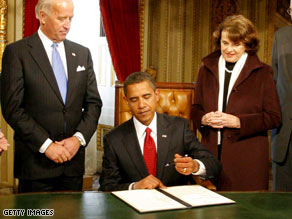
1obamaAs his first official action after being sworn in, President Barack Obama signed three documents Tuesday, including a proclamation declaring a day of national renewal and reconciliation.

“I’m a lefty. Get used to it,” Obama quipped as he signed his name.

Now, how deadpan self-revelation becomes wingnut baiting is quite the puzzler, but I anticipate people having BIG PROBLEMS with his offhand, unapologetic persona. Given shitloads of experience with such problems myself I am rather looking forward to these presidential conundrums.

new day rising

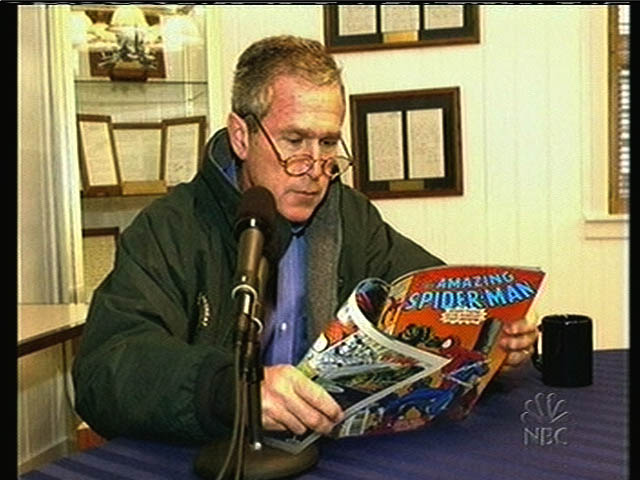
superbushI spent Monday watching the 2003 documentary Control Room, then read a mess of online farewells to George Bush. This one comes closest to what’s inside my own heart: May the Road Rise to Meet You in the Face, You Treasonous Son of a Bitch.

Contrary to the arguments made by your defenders, I didn’t root for you to fail. I never did. I greeted your installment by the Supreme Court with exhaustion and resignation, and your first few months in office with general skepticism, but I never thought, “Boy, I hope he just falls on his face and kills a lot of people and wrecks our economy and blows holes in the sand for five years.” I thought, “Maybe it’ll be okay. Maybe it won’t be so bad.”

And when 9/11 happened I said to myself and those around me, Democrats all, “Well, let’s see what he does now.” My life has not been devoid of stories about unlikely heroes arising from feckless halfwit princelings, so I was prepared for that to happen. Hopeful, even. Who doesn’t want everything to be okay? Who doesn’t recognize that you being a terrible failure would hurt us far more than it would hurt you?

I wish you had done the job. I wish you had found and tried and executed Osama bin Laden, and rebuilt Afghanistan the way we should have decades ago. I wish you had given us real security, not this dance of removing our shoes and putting lotion in a baggie. I wish you had told us to conserve and sacrifice, not spend and eat. I wish you had listened to those in the armed forces and those in Congress and those on the street when they said, don’t invade Iraq. I wish you had listened to Iraqis, afterwards, when they said, help us stop the looting and violence.

I wish you had listened to the Gulf Coast’s people when they called out for help. I wish you had listened to the sick and their doctors when they asked you to grant research to cure their disesases. I wish you had listened to women when we said, we value our autonomy.

I wish you had listened to us all when we said we are more than this, we are better than this, ask us and there’s nothing we won’t give you. I wish you had had faith in us equal to that which we placed in you. And I wish you had been worthy of what we wanted from you, and from ourselves.

I wish you had done and been all of this, but you didn’t and you weren’t, and so what we’re left with are the memories of the dead, the horrors of the living, with boarded-up houses and empty streets, a place so broken we barely recognize it anymore. It’s hard to imagine punishment fitting for that. It’s hard, having wished all this for you, to wish anything more, but I do:

May you live a life of quiet contemplation of every single one of your failures. May you live a life hemmed in by those you hurt, in a cell physical or otherwise, papered with the faces of your dead. May you be  sheltered from the rain of rotten tomatoes and sour heads of cabbage by a small, broken umbrella. May you be gnawed upon by the hunger you fostered in the poor, chilled by the cold from which you refused to shield the homeless, beset by the illnesses you refused to help cure, subjected to the indignities you inflicted upon others.

May your life be long, and healthy, and full of everything you gave to America and the world. May you come to know exactly who you are. May you come to recognize the face in the mirror each morning.

May it give to you a fraction of the nightmares you deserve.

No love at all,

A

More at the link and worth twice the time to read it once.

Eight years of international decline and what’s been lost may never be recovered. 

On my bookshelf, a small sample of elucidating prose that need never have been written:

The Dark Side

The Forever War

The End of America: Letter of Warning to a Young Patriot

The Shock Doctrine: The Rise of Disaster Capitalism

In the Shadow of No Towers

Conservatives Without Conscience

The Lucifer Effect: Understanding How Good People Turn Evil

The Wrecking Crew: How Conservatives Rule

The Great Derangement: A Terrifying True Story of War, Politics and Religion

Bush on the Couch: Inside the Mind of the President

bushmonster8sv

Two Images that sum up this administration:

bush-cheney-blank-check

baby-shoot-w

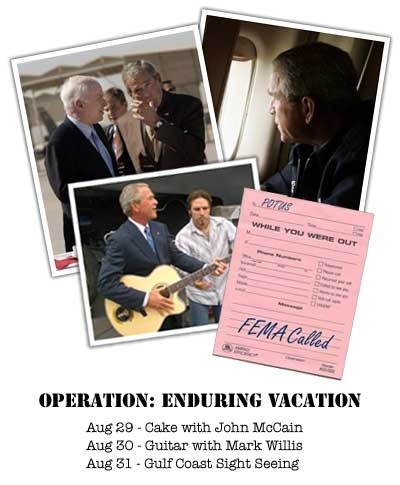
And while he was doing this:

bushenduringvacation4tn2

Our elected president flew a team of doctors into New Orleans and took complete control of the mission –  exhausted, pissed, and declining media coverage for fear it would be “politicized.”

gore

I won’t belabor what’s shaping up as the worst legacy ever, a slimeball trail future administrations will be cleaning up for life, no, enough buzz-killing. In the space of one day the tears this country flows will be of far sweeter quality, and for once I cannot wait for the speechifying to begin. Meanwhile read this smackdown of the uncomprehending winger outcry concerning our inaugural poet, Countdown to PORN and go forward laughing, citizen.

If any organism fails to fulfill its potentialities, it becomes sick. William James

Ω

The deleterious effect of evil, pernicious, stigmatizing labels is at the core of psychiatric survivor discourse™, so of course it makes me wonder why I don’t care about mine so much, like — what am I missing here, am I insufficiently outraged about a civil rights injustice?!
Borderline, Bi-polar, Schizophrenia, these official stamps of psychiatry will lead to life of ruin, they say, while saying not so much about the label that actually got them committed. Puzzling, but later for all that. The thread on BPD at the only blog that matters has me head in a spin.

I identify with borderlines, my life’s been filled with them, I have it in me, it’s a hellish disorder. I’ve only seen doctors in offices. In the room, every diagnosis came at a snail’s pace by reluctant treaters who always provided the caveat that what they do are “diagnostic IMPRESSIONS” — their best opinion, that others might not agree with, including me. Fair enough. Over many years 3 different diagnosticians gave me a Cluster B (Dramatic) Personality Disorder Not Otherwise Specified, all of them working independently without reading each others notes, and all of them placing an AXIS I diagnoses as the primary concern, whether major depression, bi-polar, PTSD, hysteria (conversion disorder) or some kind of schizophrenia. The docs I saw regularly who presumably knew me best were adamant that I do not have BPD, and I wanted that diagnosis, to feel closer to the people I love, and the musicians I relate to, all the luminous, sullen and delicate cutters.

I just last week sat down for the first time to read the opinion of the psychiatrist who evaluated me for the Social Security Administration. It’s been sitting here seven years and I’m aware that I have feelings about it before even reading it, the language is very sobering. I saw this SSA psychiatrist for 90 minutes and turns out he settled on “a long-standing and well-documented history of borderline personality disorder” with the following attached:

Dr. Aitcheson’s testimony is well-supported by the objective medical evidence, which establishes a deeply ingrained and maladaptive pattern of behavior associated with oddities of thought, perception, speech and behavior, … extreme difficulty getting along with others…panic attacks, psychotic features, vegetative states, hypersomnia… emotional lability as well as intense and unstable interpersonal relationships and impulsive and damaging behavior. This symptomatology has resulted in marked difficulties in maintaining social functioning, marked difficulties in maintaining concentration, persistence, pace, and repeated episodes of decompensation, each of extended duration.

I’m supposed to be offended by that? It’s the truth. I guess I could be offended, but appears I have a rather full plate to be upset by something so removed. I mean, it seems removed; I have my life and I have these labels. Now I finally have one that makes me chestpuff, I’m in with the out crowd.

I don’t care. That’s the problem, I am perceived as falling short in the victim identity. But listen, schizoaffective disorder was real tough on me, due to all the research it requires, but okay fuckit, overall I have no personal issues with labeling, I’m not outraged by the iffy nosology in psychiatry because the iffiness has been established for me by psychiatrists throughout my treatment course. Now I’m getting shit at Furious Seasons because what happened to me just don’t sound right. It’s a competition, this shit right here.

I feel protective and territorial about my newfound BPD label and don’t like how things are going over there. I am nobody’s victim and am sorry to say have always felt supported by my treaters, but do hang on to anger for the lobotomy and expect I always will. My gramma was the only one in that house who loved me, I saw what it did to her. Saw what psychiatrists did to my whole family, who, hang on a sec, unlike me were all involuntary patients. I guess today they’d be psychiatric survivors, since they were forced into asylums and treated against their will.

The difference between voluntary and involuntary patients is something. Seriously, cartoon king Szasz got one thing right.

Still, I am against the BPD dx for all the right reasons. People are negatively effected by that specific label in all kinds of specific ways and they don’t like it, and that should be reason enough to say it’s got to go. Period. But none of these DSM labels, invoked like mantras are what I look for when psychiatric survivors say they are sharing their feelings about what society thinks about them. The label they avoid is the one I’m most interested in hearing about  and what they do with it.

Yeah. What’s it like to be considered dangerous by the powers that be, and is it too late for me to get some of that juju?

The sole justification for involuntary commitment. You must be found to be a danger to self and or others. You might think that would make some impact on a person, an activist, a truthteller, but damned if I’m onto that discourse, in fact I’m seeing more like a taboo around meaningful discussion in the psychiatric survivors, but hey I’m borderline now, I get to stir shit up.

I realized something the other day, how the same thing happens when visiting a General Practitioner for the first time. The Physicians Assistant does the standard intake on medical history; surgeries, cancers, allergies, heart disease, mental health issues? “Yes,” I reply breezily, I’ve been treated for psychiatric conditions. “Any hospitalizations?” Why do they always look up and ask that? They do it every time, ask and look up, make eye contact and hold it.

Any hospitalizations for mental illness?

They are trying to gauge how much they need to be on guard in my presence. I guess we’re all doing that to some extent, but this makes it rather stark. I’ll remember next time to say “Nope, you’re safe!”

As am I, so far at least. I imagine that things could be different for me.

meansanta2Not another post about nuance! Yes and it all started when I heard benevolent superstar Jon Swift is offering exposure to his blogroll writers with another year-end round up of Best Posts Chosen by the Bloggers Themselves. Last year was a great success, providing hours of enjoyable reading and oodles of new visitors to the entrants’ blogs. This is not a contest, but an invitation for writers of all kinds who want a little more attention. I’m posting about it in the enduring hope of seeing psychiatric bloggers do more crossing-over into the wider progressive blogosphere. Of course you have to be on his blogroll, but since his blogroll is famous for being open to anyone I can’t imagine why anyone wouldn’t be on it.

I had little trouble choosing my own favorite post from this year’s slim pickens because I’m still pissed about that blogger from last year’s round-up who decided the most important post she wrote in 2007 was an injunction to readers to take their psychiatric meds. I don’t easily let go that sort of bullshit and it’s not because I’m against people taking psychotropic drugs. It was the compulsion to thrust her garbage onto the faceless reader as if the reader was any of her damn business, it’s that sort of foolishness gets stuck in my craw.

It looks like we’ve come full circle in one year’s time. These days the big drag in the psychosphere is seen in the browbeating of bloggers who actually do take their medication, to the consternation of antipsychiatry bullies who know for a fact that using meds does nothing but support corrupt big phRma. The DSM’s a bastard, mental illness a social construct, everybody hurts, but if you need a crutch there’s always B-Vitamins and Omega 3 fatty acid, looser! You may think this a caricature and sadly, so do I. But it’s for our own good, the twisted stigmatizing by double-talking activists who seem to think unvarnished contempt of their own (imagined) constituency is lost on anyone who believes other people’s choices are deserving of respect.

What are we to make of it? Unsolicited warnings about disabling side effects, but ZOMFG stopping drugs cold turkey without “tapering” will make you a school shooter, calling out fellow bloggers in a keyboard-pounding frenzy to justify their failure to denounce the modern tools of psychiatry, and without a single self-deprecating nod to their own fixation over this grave and pressing life and death matter.

One popular no-med blogger did just that to your shy and retiring flawedplan this year and thankfully I was able to maintain sufficient wit to persuade her to swiftly remove the nonsensical post but these displays of nerve can leave a chilling effect. And they’re accumulating, some phase, the pendulum swinging, whatever the reason, antipsychiatry abounds. Yes I know, google antipsychiatry and you’ll end up here, isn’t that ironic. Something’s gotta give.

Just this October while cleaning out my medicine cabinet I found a two year old bottle of un-opened Effexor and decided I’d take one a day to see what it did to my mind. First time I try psych drugs in over three years but can’t bring myself to share this experiment on my own damn blog because who wants to fight with competitive antipsychiatry ass berets? That’s fucked up . And more fool me, being so wilting lily sensitive but
when
I
can
I
will
so let the record show, Effexor kicked ass in the third week, got me talking to people, telling jokes, on the phone and off my computer, playing with kids, looking up at the sky above, cornbread moon and twinkly stars, take that, assholes! all very banal and run-of-the-mill, a mood elevator doing what it was designed to do, someone better call Ripley. But I dreaded the outcry — Placebo effect!– Uh huh, and it only took 32 trials with prior “placebos” til Effexor hit the sweet spot, what a mystery these dadgum sugar pills, 31 fakes til the real placebo kicks in.

Now, wait just a dadblasted minute. Did I not just say I’ve been off psych meds for three full years and now I’m going on about undergoing 32 drug trials? Which is it, what gives? I get these triumphant gotcha emails and don’t know what to make of them that seem to be saying “Come Clean!”

Because nothing says you’re filling a necessary void like an excruciatingly detailed exposition of your journey with psychotropic medications, therefore a blogger is beholden to describe her course in its entirety, stops and starts, gains and losses, why I changed my mind, then changed my mind again, til I came upon the final wisdom, whether from compliance to non-compliance or non-compliance to compliance and the road back to where I was before the meds destroyed my fill-in-the-blank, the fact of the matter is every veil that falls from my eyes will be validated by matching veils falling from your own. Or else.

Else what?

You can face the pathetic need to have complete strangers put their stamp on your own life choices or you can assume the identity of a pharmaceutical fetishist, choose to troll blogs, shut down discussion, expect everyone to be similarly obsessed with pharmaceuticals in a vain attempt to normalize batshit insanity by projecting your issues into the environment, which no one in the history of the world has ever tried before.

They’re out there. Trolls are meant to be smacked down, though I wouldn’t call them concern trolls, because they’re incapable of misrepresenting the concern part of the concern troll protocol. It seems more like a minority of angry antipsychiatry usurpers have united in an effort to seize the mental health discourse, make discussion ugly for any mental health blogger inclined to post about a casual relationship with said drugs and prescriber, who gives the topic due proportion, as an aside, one detail in a multi-faceted narrative. Not to mention any blogger who feels conflicted about using pharmaceuticals, you will watch your mouth or rue the day you turned off comment moderation.

Antidepressants aren’t that interesting, they are just the device in a battle of wills. It’s about control, over-powering the blight of personal sovereignty by those who feel personal sovereignty was stolen from them, and by the looks of things it was. But there has to be a way of reclaiming what’s yours without destroying the self-esteem of psychiatry’s willing guinea pigs as if their peace of mind is what’s wrong with this picture.

Perhaps I’ve gone far afield of the original subject, but it seemed some preamble was in order. I’ve come to realize that anticipating a jump to conclusions has become necessary in blogging and guess there’s nothing to be done for that but learn to address it in fewer words. I’ll aim high, meanwhile my favorite 2008 post at Writhe Safely remains this one, but I won’t submit that since it’s pure link love, I didn’t write anything. My own best typing in 2008 combines social criticism with personal confession (and if you think I exaggerate the violence of online antipsychiatry read that thread) but will submit this instead with a thought for public service. If you come away from that convinced of what I stand for you are privy to a truth that is not even in my own possession. Why would you want that responsibility? Just think about the post, not a bunch of interesting ideas about the person who wrote it.

Right now I am thinking of various mental health bloggers who deserve a wider audience. Here’s hoping half my blogroll makes an appearance in Jon Swift’s self-selected personal bests for Election Year 2008! I’ll be clicking along with my Christmas toddy, in solidarity, basking in the plenitude of complimentary hits.

Catch a fire

It’s not everyday reading something on the Internet can move me to tears, but I’ve given up hope on seeing something like this post (and commentary) at Whiskey Fire. The study is not yet published and I know it only begins to scratch the surface but for the first time since the tests were done on me I have hope, if not for myself I can imagine glad tidings for tomorrow’s little Dickens.

When the neuropsychologist laid it out for me 10 years ago I was crying and he was almost crying, because he couldn’t answer my very pointed questions and account for the disparities in my mental examination. An evaluation spanning eight hours over two days, as comprehensive as it gets, followed by a 25 page report and two hour debriefing and still something missing hangs in the air. In the end I knew that he knew and we both knew what I needed to hear that he couldn’t say. What I didn’t know was that he couldn’t say it because there was no supporting cognitive science to make our unspoken hypothesis official in a formal setting. Correlation is not enough to move the world off its ass, but I have had enough correlation to last a lifetime, and that time is running out. Catch up with me.

He tried to make me feel better like Jake the Snake talks at Whiskey Fire — it’s not a life sentence, keep building up strengths, focus on your incredible resilience and amazing inner resources. Oh please. Show me the science.
Now we’re talking. It’s a start.

“This is a wake-up call…these kids have no neurological damage… yet, the prefrontal cortex is not functioning as efficiently as it should be….researchers suspect that stressful environments and cognitive impoverishment are to blame…The study is suggestive and a little bit frightening that environmental conditions have such a strong impact on brain development…”

Suggestive and a little bit frightening indeed.

I often wonder what it will look like to reach the point of not just surviving my misfortunes but being simply and profoundly grateful for every single thing that has ever happened to me. And why people who want things like that are so perplexing to those who don’t. Those who wonder, in their golden ways what’s so funny about gallows humor, the sole comfort of those who’ve escaped the hangman and an affront to those who have no knowledge of his existence.

Welp, there it is, in black & white, no less.

Thanks

by W.S. Merwin

Listen
with the night falling we are saying thank you
we are stopping on the bridges to bow from the railings
we are running out of the glass rooms
with our mouths full of food to look at the sky
and say thank you
we are standing by the water thanking it
smiling by the windows looking out
in our directions

back from a series of hospitals back from a mugging
after funerals we are saying thank you
after the news of the dead
whether or not we knew them we are saying thank you

over telephones we are saying thank you
in doorways and in the backs of cars and in elevators
remembering wars and the police at the door
and the beatings on stairs we are saying thank you
in the banks we are saying thank you
in the faces of the officials and the rich
and of all who will never change
we go on saying thank you thank you

with the animals dying around us
our lost feelings we are saying thank you
with the forests falling faster than the minutes
of our lives we are saying thank you
with the words going out like cells of a brain
with the cities growing over us
we are saying thank you faster and faster
with nobody listening we are saying thank you
we are saying thank you and waving
dark though it is

Grazing the Internets this weekend is to follow intimate, overheard snippets in the shaping of a legacy. So I compile what the people are saying in a downright tsunami of link love, the hours well spent.

Studs Terkel 1912-2008

“The thing that horrifies me is the forgetfulness.”

A cigar and martini man, white-haired and elegantly rumpled in his trademark red-checkered shirts, an old rebel who never mellowed, never retired, never forgot, and “never met a picket line or petition I didn’t like.”

He won a Pulitzer Prize for listening to other people’s thoughts, fears and dreams

which he called guerrilla journalism

but writer Garry Wills described as “underdog-ism”

used his words, whether on radio or on the page, to celebrate the People with a capital “P” and to protest their oppression by the stupid and powerful

whose searching interviews with ordinary Americans helped establish oral history as a serious genre

married for 60 years to a beautiful woman named Ida

a social worker

“Ida was a far better person than I, that’s the reality of it,” Terkel wrote of Ida, who died in 1999.

Studs relied on Ida for, well, almost everything

“It was those loners — argumentative ones, deceptively quiet ones, the talkers and the walkers — who, always engaged in something outside themselves, unintentionally became my mentors,” Terkel wrote in “Touch and Go.”

When Ida grew older she refused to use a cane, “because I fall so gracefully”

he was envious that her FBI file was thicker than his own.

He chronicled the lives of almost everyone who mattered–the hundreds include Martin Luther King, Bob Dylan, Woody Allen, Toni Morrison. Just as important, he chronicled the lives of those who officially didn’t matter, and in doing so made us understand they did.

He searched for the decency in everyone

illuminated America from the ground up, seeking out stories from bartenders, housewives, businessmen, artists, doctors, social workers, coal miners, farmworkers, bookmakers and convicts

coaxed extraordinary tales out of nobodies

shined a light on the kinds of people that most people look right through

the ghost-town storekeeper in Kentucky who says: “The last flicker of my life will be against something I don’t think has to be”

completely free of sociological claptrap, armchair revisionism and academic moralizing

His method was to travel the country, sometimes for years, interviewing hundreds of people about some enormous epoch or theme. Terkel essentially asked everyone a simple question: What was it like?

The result — a series of oral histories — was the poetry of ordinary people, shot through with desperation, hatred, love, dreams realized and lost

Shame about losing a job and going “on relief.” Shame about not being able to provide for one’s family. Shame about the breakdown of families and, almost, the fabric of an entire society.

police officers and convicts, nurses and loggers, former slaves and former Ku Klux Klansman — a typical crowd for Mr. Terkel

“To count is very important.”

“Who built the pyramids?” he once asked in his inimitable sweet growl. “It wasn’t the goddamn pharaohs who build the pyramids. It was the anonymous slaves.”

Terkel’s politics were liberal, vintage FDR. He would never forget the many New Deal programs from the Great Depression and worried that the country suffered from “a national Alzheimer’s disease” that made government the perceived enemy.

“How did the eight-hour day come into being? It began in Chicago and four guys got hanged for it—the Haymarket affair in 1886. What were they fighting for? The eight-hour day.”

He wrote about “the good fight” of World War II because he wanted to remind new generations of Americans that this country had once united to battle fascism.

It would be wrong to say Terkel was colorblind…he was deeply curious, deeply intrigued with all colors of the rainbow…not afraid of other cultures…the only white writer to be inducted into the International Literary Hall of Fame for Writers of African Descent at Chicago State University… The approval vote was unanimous.

Studs developed self-deprecatory clowning to a high art–getting into pitched battles with recording equipment, for instance — as a tactic for putting anxious interview subjects at ease. Authors on his show were almost invariably impressed by how he would enter the studio with their books scored with his scrawled notations as if he were preparing a term paper.

“It isn’t an inquisition; it’s an exploration, usually an exploration into the past,” he once said, explaining his approach. “So I think the gentlest question is the best one, and the gentlest is, ‘And what happened then?’”

As you listen, you know in your bones that each person has never told their story as cogently or as fully before and will never do so again, for that was Terkel’s art.

“He liked to tell the story of an interview with a woman in a public housing unit in Chicago. At the end of the interview, the woman said, ‘My goodness, I didn’t know I felt that way.’ That was his genius.”

He didn’t just carp at the failures of society, he was a drum major for life—a celebrant of the joy of living.

Politics was never a game for Studs. It was the work of a lifetime. He wrote brilliant books about the lives of working people not merely because their stories were fascinating but because he wanted to get a conversation started about class in America.

My friends and I would sit around the radio like it was a little fire we warmed ourselves by. He read everything. He led such an examined life. He remembered everything.

Our Boswell, our Whitman, our Sandburg

“She was really something,” Studs recalled, “with that gardenia in her hair.” Holiday once sang Willow Weep for Me for Terkel and nine other people. “We weren’t weeping for her, we were weeping for ourselves,” he later said, “That’s an artist.”

There was the time he was robbed in his house. The thief said “GIVE ME ALL YOUR MONEY” so Studs gave him all his money from his pocket. The thief turned to go and Studs said “Wait a minute! Now I’m broke! Give me twenty bucks!” The thief smiled and peeled off a twenty, then left. Classic.

People call Terkel’s business “oral history”, but it is more like the weaving of a fabulous verbal tapestry, the threads of which are human preoccupations. It is the rich art of taking the vernacular, and making it eternal. Such a process does not merely record the details that keep people’s minds busy, it gives them value. Terkel harvested not only the most complete American history of this century, but the most compassionate.

“My epitaph? My epitaph will be, ‘Curiosity did not kill this cat,’” he said. He then said that he wanted his and Ida’s ashes to be scattered in Bughouse Square, that patch of green park that so informed his first years in his adopted city.

Bughouse Square, the park across the street from the Newberry Library that was home to all manner of soap box orators.

“Scatter us there,” he said, a gleeful grin on his face. “It’s against the law. Let ‘em sue us.”

Older Posts »